
The Paradox of VibeThinker:3B — SOTA Reasoning, Futile Agency
In June 2026, Weibo AI introduced VibeThinker:3B, a 3-billion-parameter model that disrupted the conventional correlation between model scale and reasoning capability. Built on the Qwen2.5-Coder-3B foundation, VibeThinker:3B matches or exceeds frontier models orders of magnitude larger on highly structured reasoning benchmarks.
Yet, when integrated into autonomous agentic coding frameworks (such as SWE-bench environments or multi-tool developer loops), the model’s performance degrades rapidly. This analysis explores the technical architecture driving VibeThinker’s success and the underlying limitations that prevent its application in agentic workflows.
Benchmarks: Redefining Efficiency in Closed-World Logic
VibeThinker:3B was optimized using a post-training pipeline based on the "Spectrum-to-Signal" principle, aligning with the Parametric Compression-Coverage Hypothesis. This hypothesis posits that verifiable reasoning (stemming from mathematics and strict code syntax) is highly compressible because its state space is bounded and mathematically verifiable.
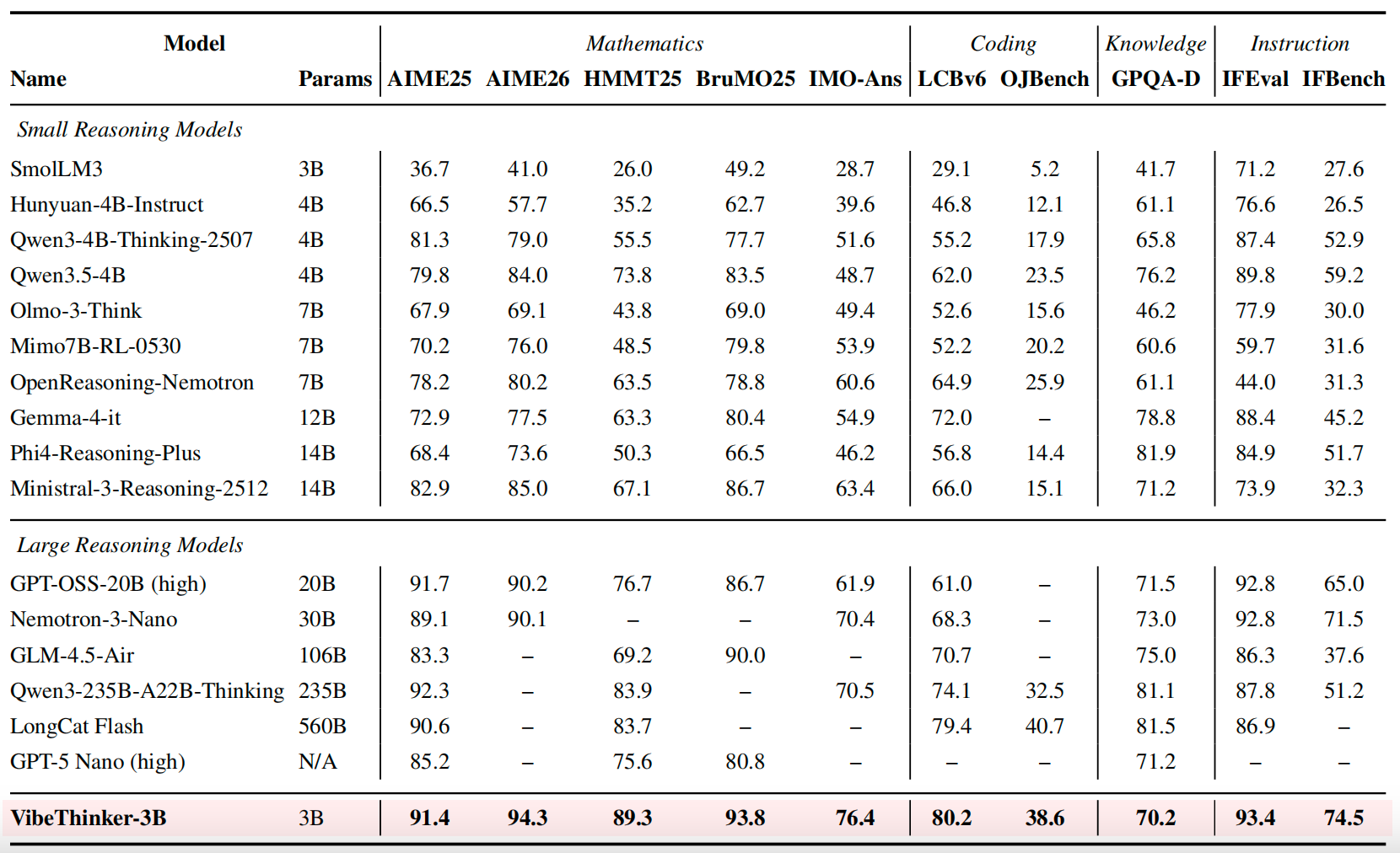
The model achieves exceptional results in isolated logical environments:
- AIME26: 94.3% accuracy under test-time scaling configurations, competing directly with GPT-4o and Claude 3.5 Sonnet.
- LiveCodeBench v6: 80.2% Pass@1, validating its proficiency in algorithmic code generation.
- LeetCode Contests: 96.1% acceptance rate on previously unseen evaluation sets.
Why VibeThinker:3B Falters in Agentic Ecosystems
Despite superior mathematical and syntax capabilities, VibeThinker:3B fails when tasked with operating as an autonomous software engineer. The bottleneck is not its reasoning capacity, but its structural and parametric limitations in three critical areas:
1. Absence of Tool-Calling and API Orchestration Calibration
An autonomous coding agent must continuously interact with its environment: reading directory structures, writing files, executing terminal commands, parsing compiler diagnostics, and query-searching documentation.
- The Constraint: VibeThinker:3B was not calibrated for tool-calling, function execution, or multi-step API orchestration.
- The Trade-off: Fine-tuning a 3B model to output structured tool calls (like JSON schemas or XML blocks) while preserving its high-density reasoning capacity results in severe capability regression. Weibo AI deliberately prioritized raw logical density over environmental interface capabilities.
2. The Gap Between Closed-World Solvers and Open-World Agents
- Closed-World Reasoning: Problems presented in competitive math or coding tests are self-contained. The inputs, parameters, and expected outputs are clearly defined. The reasoning path is linear and objective.
- Open-World Exploration: Software development is non-linear and ambiguous. An agent must ingest massive codebases, trace dependencies, handle silent failures, and adapt when tests fail. This requires a level of pragmatic reasoning and context management that 3B parameter models lack the capacity to store.
3. Context Retention and State-Machine Tracking
Agentic loops generate long execution histories, accumulating tool outputs, command results, and code diffs. Under standard architecture, a 3B parameter model struggles to maintain high-fidelity attention over long, noisy contexts. The attention mechanism loses the target plan amidst the verbose logs of compilers and test runners, leading to loop degradation or repetitive execution errors.
Architectural Verdict: The Multi-Model Synergy
VibeThinker:3B demonstrates that advanced reasoning can be compressed into edge-capable models. However, it highlights that agency remains a property of scale.
Rather than deploying VibeThinker:3B as the primary orchestrator of an agentic workflow, optimal implementation involves a heterogeneous multi-model architecture:
- The Planner (Large Model): Use a larger, tool-optimized model (e.g., Claude 3.5 Sonnet or GPT-4o) to handle codebase exploration, state management, and tool routing.
- The Specialist (VibeThinker:3B): Route complex, self-contained mathematical logic, algorithm generation, or local code verification tasks to VibeThinker:3B.
By decoupling system orchestration from core logical deduction, developers can leverage VibeThinker’s efficiency without encountering its agentic limitations.